
Pulp mill cuts bleaching plant steam use by 22% with WideGap heat exchangers
One of the oldest pulp and paper mills in Minnesota, United States, faced a steam capacity problem when installing an additional paper machine. To reduce pressure on the boiler system, the mill identified the bleaching plants as the priority area for energy savings. By installing three Alfa Laval WideGap plate heat exchangers, the mill could utilize waste heat to preheat reused washing filtrates, reducing bleaching steam use by 22% and saving $27,000 per month. The project paid for itself in less than a year.
DATE 2026-07-06A new paper machine pushed the boiler to its limits
When the mill added a new paper machine, overall steam consumption climbed to near the maximum capacity of the boiler. The mill operates a kraft pulp mill, two bleaching plants and two paper machines.
Rather than investing in expanding boiler capacity, the mill's technical team conducted a site study to identify where steam could be saved most cost-effectively.
The study pointed clearly to the bleaching plants. Heating pulp to bleaching temperatures accounted for 5 to 6% of total steam production, which was a significant drain. The technical director determined that preheating reused washing filtrates with waste heat from the digester blow could significantly lower steam demand.
The engineering challenge was the filtrates themselves. Washing filtrates contain suspended fibres, which rules out most conventional heat exchanger designs. Standard shell-and-tube units carried a serious risk of clogging, making continuous operation unreliable and maintenance-intensive.
In addition, shell-and-tube heat exchangers require large temperature differences between the fluids, reducing their ability to effectively utilize recovered waste heat.
* Shell-and-tube heat exchangers require a larger temperature difference between the fluids due to a less effective flow arrangement and lower heat transfer efficiency, making it difficult to achieve a tight temperature approach.
In contrast, plate heat exchangers enable very close temperature approaches, maximizing heat recovery, reducing the required heat transfer area, and deliver ing a more compact footprint.
A one-month test pilot led to a full-scale installation
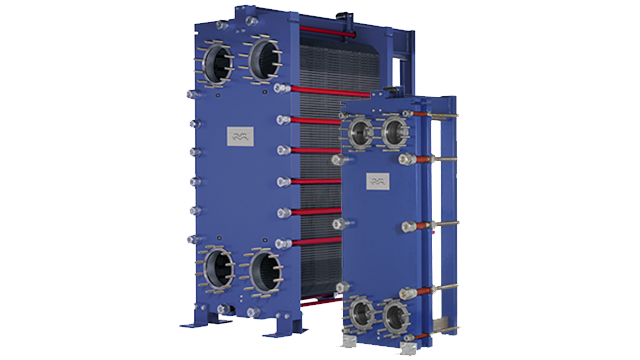
Alfa Laval proposed the WideGap plate heat exchanger, a technology developed specifically for efficient heat transfer in fibrous fluids. The WideGap has optimized free channels between the plates, enabling fibres to flow through the channels effectively while still maintaining efficient heat transfer. Rather than committing immediately to a full installation, the mill agreed to trial a single unit on a filtrates side stream.
The test ran for one month. The pressure drop did not increase, and clogging was avoided effectively. With confidence in the technology, the mill decided to scale up to a full production installation. Two additional units were installed, bringing the total to three WideGap heat exchangers operating across the bleaching plants.
Each unit uses waste heat from the digester blow condensate to heat the bleaching plant washing filtrates. The filtrates are raised from 15 to 20 °F before it is reused for pulp washing. During washing, this heat is transferred to the pulp. In practice, this means substantially less steam is needed to reach the desired temperature in the bleaching towers.
The three heat exchangers delivered an important reduction in energy consumption. During the best three-month period, steam use in the bleaching plants fell by 22%. The mill now sees monthly savings of $27,000 per month, and the project paid for itself in less than one year.
Compared to shell-and-tube heat exchangers, the WideGap technology
- weigh significantly less
- require less floor space and headroom
- allow fibres to pass without unnecessary clogging
- allow a closer approach temperature, enabling greater utilization of recovered heat
Efficient heat transfer solution for paper and pulp industry
This project shows that significant steam savings in bleaching plant operations can be achieved through two steps: identifying where heat is already available, and then finding a reliable and efficient way to transfer it to a process stream that needs it.
The barrier in similar applications is not the heat source, but the fluid handling. Washing filtrates containing fibres are sometimes considered difficult to run through heat exchangers. However, with the right exchanger design, this engineering constraint can be removed, and with payback measured in months rather than years, similar projects demonstrate strong financial feasibility.