
Alfa Laval plate heat exchanger condenser are saving space and increasing productivity
For years Brunner Mond used tubular Caisse heat exchangers as ammonia still condensers at their soda ash plant in Northwich, England. However, as time passed, the tubes became older and more prone to corrosion and began to leak. The plant engineers faced the problem of whether to shut down the process for re- tubing or find an alternative method. The solution was an Alfa Laval plate heat exchanger condenser which not only improved productivity and reduced maintenance but took only a fraction of the space.
DATE 2023-11-28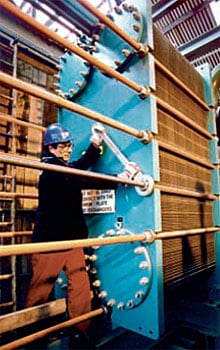 Brunner Mond produces soda ash primarily for the glass industry using the Solvay process. The basic raw process materials are limestone and sodium chloride treated in a series of controlled chemical reactions. During processing a gaseous mixture consisting of ammonia, carbon dioxide and water vapour emitted from the ammonia still must be cooled so that the ammonia and carbon dioxide can be reintroduced to the process. The water vapour must be removed in a condenser in order not to dilute the process.
In the past Brunner Mond had used gigantic Caisse tubular heat exchangers to serve as a condenser and feed liquor preheater. The Caisse unit which was situated adjacent to the ammonia still column measured 14 metres (46 feet) in height and 2.7 metres (9 feet) in diameter and was designed to reduce the temperature of the gas mixture from 850 C (1850 F) to 600 C (1400 F). The problem was simply that as the tubes got older, the Caisse cooler had become more subject to corrosion and began to develop leaks which had to be plugged on a regular basis.
Re-tubing – time-consuming, expensive and labour-intensive
Re-tubing was a time-consuming, expensive and labour-intensive process which required the total shutdown of the cooler to allow the maintenance staff to enter the structure and plug the leaks. This in turn meant that the heat transfer area available decreased for each subsequent plugging. Plant engineers realised that eventually the unit would require either complete re-tubing or replacement. Since re-tubing would take the process out of operation for up to three months, replacement seemed the most feasible alternative. But the case was further complicated by a limited amount of space available for the installation.
Brunner Mond asked three heat exchanger suppliers to present solutions to the duty. One refused to quote on the project; the second offered a solution which was not feasible.
The third company, Alfa Laval, worked with Brunner Mond to develop a solution which not only resolved the problem but actually improved operating efficiency and reduced maintenance and occupied only a fraction of the space.
Corrosion-resistance, easy service and close temperature control
To replace the existing Caisse cooler, Alfa Laval proposed two plate heat exchangers (PHEs), one condenser in titanium and one feed liquor preheater in titanium. Plates in titanium minimise the risk of corrosion while the plate heat exchangers’ compact and easily accessible design solve service and maintenance problems. In contrast to the original Caisse coolers, plate heat exchangers can be maintained and serviced on site within their installed space with a minimum of disruption of the process.
Moreover, Alfa Laval’s solution using fresh water to cool the gas to the correct temperature provides close control of gas and condensate temperatures and prevents overcooling of the condensate. The fresh water heated in this process stage is then used for preheating the feed liquor. After preheating the suitably cooled water is recycled to the condenser to complete the cooling process once again. Problems with feed liquor fouling are restricted to a single plate heat exchanger which is easily accessible for service and maintenance.
However, the most striking savings is the amount of space saved. The plate heat exchanger condenser measures 3.5 metres (11 1/2 feet) in height, 1.4 metres (4 1/2 feet) in width, and 3.5 metres (11 1/2 feet) in length in comparison with 14 metres (46 feet) and 2.7 metres (9 feet) in diameter for each Caisse cooler.
A spokesman for Brunner Mond testifies that “the system is extremely reliable and responds quickly to changes in feed rates and conditions. The larger gas condenser unit has shown no tendency to fouling, even after four years of continuous use”. In fact, the concept has proven so successful that over the period of five years a large number of PHEs have been installed at Brunner Mond plants in Northwich.
The plate heat exchanger
The plate heat exchanger consists basically of a number of corrugated plates mounted in a frame and arranged so that the two fluids flow in alternate channels. The fluids between which heat is to be transferred are sealed to the atmosphere by gaskets or welds on one or both media channels. Plate corrugations impart turbulence to the fluids which prevents fouling.
In addition to preheating of feeder liquor, applications for the liquid-to-liquid plate heat exchanger in soda ash production include:
- Cooling the circulating ammoniated brine from the ammonia absorption tower
- Cooling the precarbonated brine for the carbonating tower.
The plate heat exchanger as a condenser
Plant engineers often consider the plate heat exchanger to be a typical liquid-to-liquid heat exchanger but the plate heat exchanger has, in fact, been serving as a condenser in a wide range of process conditions for many decades. The plate heat exchanger condenser has been successfully used for such varying duties as steam heating, condensing in distillation and evaporation systems and cooling of gases containing water vapour such as ammonia still condensing.
The vapour to be condensed enters the unit via one of the upper connections in the frame. The vapour flows in each second channel while the cooling media flows, normally counter-currently, in alternating channels. Condensation starts as soon as it touches the plate surface and the condensate plus any residual vapour/gas is withdrawn from the lower connection and passed to a vapour/liquid separator.
Product
The AlfaCond is the first plate condenser in the world specifically designed for low-pressure vapour condensation in all types of industries.
Benefits
The construction of the plate heat exchanger offers the
following advantages:
- Small surface area permits economic use of expensive
materials such as titanium - High overall heat transfer coefficients
- Small space requirement with no extra space required for maintenance
- Very low weight requires lighter foundations; low hold-up volumes provide faster response to control functions
- Flexible design permits rearrangement to meet new
process conditions - Non-gasketed constructions available for vapour for flammable or toxic substances
Customer's voice
The system is extremely reliable and responds quickly to changes in feed rates and conditions. The larger gas condenser unit has shown no tendency to fouling, even after four years of continuous use.
A spokesman for Brunner Mond