
Alfa Laval increased capacity at half the price at Kemira Kemi AB
At Kemira Kemi AB in Helsingborg, Sweden, calcium chloride is one ofmany base chemical products produced. Today Kemira concentrate the calcium chloride in a multiple-effect evaporation system using rising-film tube evaporators in Monel.
DATE 2025-12-17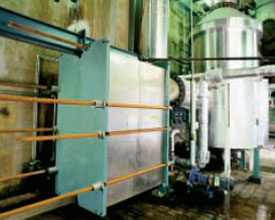 The lifetime of the tubes is limited and Kemira knew that within the course of a few years they would need to replace three of the shell-and-tube evaporators. Therefore in 1995 they approached Alfa Laval for replacements for the shell-and-tube evaporators.
Alfa Laval proposed the plate evaporator and Kemira agreed to install a test unit to run comparative tests. The results demonstrated that the plate evaporator worked excellently and had more than twice the heat transfer coefficient of the shell-and-tube evaporator which meant that a new plate evaporator effect would require only half the heat transfer area. Operation also showed that the plate evaporator had no fouling problems.
Kemira evaporate the calcium chloride in a multiple-effect system before it is dried to a solid salt. The existing system was a series of Kestner evaporators with 5.5 metre long Monel tubes with a carbon steel shell. Replacement of an entire effect would be extremely costly.
Alfa Laval proposed replacing the third effect with a plate evaporator in titanium with an area half that of a new shell-and-tube evaporator and at half the cost of the shell-and-tube unit. Since Kemira had had no experience with the plate evaporator and wanted to test the unit, Alfa Laval agreed to provide a test unit to serve as a booster in parallel with one of the existing effects for a period of five months.
During the test period, one third of the flow was directed to the plate evaporator and the remaining two-thirds was treated in the existing shell-and-tube evaporator. In the plate evaporator the calcium chloride was evaporated from 27 to 36 percent at 110 C (230 F) using secondary steam from the previous effect at 120 C (248 F).
During the five months the plate evaporator was in operation, the unit maintained more than double the heat transfer value achieved by the shell-and-tube evaporator. Some fouling occurred but no cleaning was necessary and it was determined that cleaning-in-place with weak hydrochloric acid once a year should be sufficient to keep the unit free from fouling.

Order for one plate evaporator to replace the complete third effect
Both Alfa Laval and Kemira agreed that test results confirmed the operational values promised by Alfa Laval. Kemira were so satisfied with the plate evaporator’s performance that three months after the completion of the tests, they ordered a plate evaporator in titanium to replace the complete third effect. In the near future, there is further potential to replace two more effects as they become obsolete.
Sven Ove Uhrbom, production manager of Kemira’s calcium chloride plant, says “The unit has now been in operation for six months and is operating well. There has been no need to clean the unit. Furthermore, we have observed an increase in capacity despite a heat transfer area which is only half that of the shell-and-tube units.“
The plate evaporator
Alfa Laval’s plate evaporator is a rising-film evaporator with a plate pattern specially designed for evaporation duties. With high-viscosity products, the plates’ corrugated pattern induces turbulence which increases heat transfer. The plate evaporator uses only a fraction of the floor space in comparison with bulky shell-and-tube heat exchangers. At the same time, its compact dimensions make it considerably less expensive when high-alloy materials are required.
The plate evaporator consists of a plate pack assembled between a frame plate and pressure plate and compressed by tightening bolts. The plate pack is formed by a series of welded cassettes. Traditional gasketed channels are formed by gaskets between the welded cassettes. Evaporation normally takes place in the gasketed channel while the heating vapour flows through the welded channel.
The product inlet is located at the bottom of the unit and the heating vapour inlet at the top. The connections can be placed on either the frame plate or the pressure plate. The standard plate material is AISI 316 but plates are available in any pressable material including titanium, palladium-stabilised titanium, nickel and Hastelloy. The standard gasket materials are EPDM or Nitrile but other elastomers are available on request.
Alfa Laval in brief
- Alfa Laval is a leading global provider of specialized products and engineered solutions. Our equipment, systems and services are dedicated to helping customers to optimize the performance of their processes. Time and time again.
- We help our customers to heat, cool, seperate and transport produccts such as oil, water, chemicals, beverages, foodstuff, starch and pharmaceuticals.
- Our worldwide organization works closely with customers in almost 100 countries to help them stay ahead.
Product
AlfaVap plate evaporators are specially designed for condensing and evaporation. They combine the benefits of compact, efficient plate heat exchangers with the low pressure drop required for these duties.
are specially designed for condensing and evaporation. They combine the benefits of compact, efficient plate heat exchangers with the low pressure drop required for these duties.
Benefits
- Half area in the factory
- Half the investment cost compared to the shell-and-tube unit
- More than twice the heat transfer coefficient of the shell-and-tube evaporation
- Half the heat transfer area
- No fouling problems
Customer's voice
We have observed an increase in capacity despite a heat transfer area which is only half that of the shell-and-tube units.
Sven Ove Uhrbom
Production manager of Kemira's calcium chloride plant