
Full-scale comparison of decanter centrifuge and screw press performance for municipal sludge dewatering
Sludge dewatering has a significant impact on the operating costs and environmental performance of municipal wastewater treatment plants. Although decanter centrifuges and screw presses are widely applied for sludge dewatering treatment, their different separation principles result in distinct operational characteristics and performance trade-offs. A full-scale side-by-side comparison between these technologies at a municipal wastewater treatment plant in Finland demonstrated unexpected differences in cake dryness, solids recovery, centrate quality and overall process impact, highlighting the importance of evaluating dewatering technologies based on total system performance rather than individual operating parameters.
DATE 2026-08-28
Sludge dewatering technologies
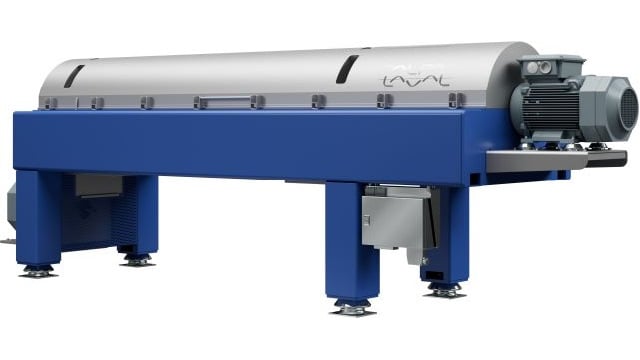
Decanter centrifuges utilize centrifugal forces to accelerate particle settling, cake compaction and separation, typically achieving high solids recovery and dry cake at high throughput. Screw presses rely on gradual mechanical compression through a dewatering screen or disck and are generally recognized for their relatively simple design and low electrical power demand.
Selecting between these technologies requires balancing several process performance criteria, including:
- cake solids concentration
- solids recovery
- polymer consumption
- energy demand
- centrate quality
- operating costs
- maintenance requirements
To evaluate these trade-offs under real operating conditions, Alfa Laval Senior Engineer Tim Mikkelsen, specializing in sludge dewatering technologies, conducted a full-scale comparative investigation of decanter centrifuges and screw presses at municipal wastewater treatment plants across the Nordic region. This case study presents the results of a side-by-side comparison between a decanter centrifuge and a moving-disc screw press installed at a municipal wastewater treatment plant in Finland serving approximately 12,000 population equivalents (PE).
Comparative performance of decanter centrifuge and screw press dewatering technologies
Both systems were operated under comparable full-scale conditions using identical feed sludge. Performance was evaluated based on key operational and dewatering performance indicators, as summarized in Table 1.
The screw press produced an average cake solids concentration of 18.1% at a solids recovery of 97.8%. Under conservative operating conditions characterized by relatively low bowl speed and high differential speed (low torque), the decanter centrifuge achieved 20.0% cake solids and 99.5% solids recovery while producing centrate containing less than 300 mg/L suspended solids. Following optimization of the operating parameters, the decanter achieved 22.7% cake solids while maintaining comparable solids recovery, representing an improvement exceeding 4.5 % points in cake dryness compared with the screw press.
When evaluating dewatering technologies, it is important to look beyond cake dryness and energy consumption alone. In this 360 comparison, the decanter achieved improved dewatering performance while reducing polymer demand by approximately 60% and wash-water consumption by a factor of 3.2 compared with the screw press for an operating schedule of eight hours per day. For plants operating continuously, the differences would become even more significant,” says Tim Mikkelsen, Senior Engineer at Alfa Laval.
The relative importance of these performance factors depends on site-specific economic drivers. In this case study, dewatered sludge is transported to a centralized biogas facility for anaerobic digestion, meaning that cake dryness is less economically significant than at facilities where sludge disposal costs are directly related to the mass of sludge transported.
Similarly, the potential benefits associated with improved centrate quality are not currently included in the plant's operational cost evaluation. Compared with the screw press, the decanter produced centrate with lower suspended solids, BOD and ammonia (NH₄-N) concentrations, thereby reducing the recycle load returned to the biological treatment process. Lower recycle loads reduce the demand for aeration and nutrient removal, decreasing the burden on the activated sludge process. Based on the measured differences between the screw press filtrate and the decanter centrate at the Finnish plant, the associated downstream treatment cost savings are estimated at approximately €0.26 per m³ of sludge treated.
Also, the potential operational benefits associated with the smaller equipment footprint were not included in the economic evaluation. The decanter installation occupies approximately 5 m², compared with 7.5 m² for the screw press, while providing more than twice the treatment capacity per unit footprint (2.4 m³/h/m² versus 1.06 m³/h/m², respectively). The smaller footprint may also offer environmental and infrastructure benefits by reducing space requirements for new or upgraded installations.
In conclusion, screw presses provide advantages in terms of lower capital cost, lower direct energy consumption and operational simplicity. However, this study demonstrates that these benefits can be outweighed by lower dewatering performance, resulting in higher polymer consumption, increased recycle loads and additional downstream treatment costs. Selecting dewatering technology based solely on investment cost and power consumption may therefore overlook significant lifecycle operating costs and process benefits.
Highlighted Technologies
|
Screw press |
Decanter centrifuge (conservative setting) |
Decanter centrifuge (optimized parameters) |
|
|---|---|---|---|
|
Operational parameters |
|||
|
Throughput |
8 m³/h |
12 m³/h |
12 m³/h |
|
Electrical energy demand |
0,2 kWh/m3 |
0,73 kWh7m3 |
0,99 kWh/m3 |
|
Polymer consumption at 0,16% concentration |
4,1 kg/t DS - 830l/h |
2,5 kg/t DS - 760l/h |
2,5 kg/t DS - 760l/h |
|
Wash-water consumption |
600 l/h (4,8 m3/ per 8 hour) |
1,5 m3/ per 8 hour Recommended flush |
1,5 m3/per 8 hour Recommended flush |
|
Dewatering performance parameters |
|||
|
Average cake solids concentration |
18.1% DS |
20.0% DS |
22.9% DS |
|
Centrate suspended solids |
1000 mg/L |
230 mg/L |
370 mg/L |
|
Solids recovery |
97.8% |
99.5% |
99.0% |
Table 1
The screw press demonstrated six times lower direct electrical power consumption at equal centrate quality but required:
- Higher polymer consumption
- Much wetter cake
- Lower solids recovery
- 3,2 times higher wash water consumption based on 8 hours running time/day
- Increased recycle loads to the wastewater treatment process
The decanter centrifuge consumed more electricity but consistently produced:
- Higher cake dryness (20.0–22.7% DS versus 18.1% DS)
- Cleaner centrate while maintaining comparable throughput
- Improved solids recovery (99.5% versus 97.8%)
- 60 % lower polymer demand
Subscribe to our Wastewater Newsletter
Sign up to receive monthly insights from across the water and wastewater industry, delivered straight to your inbox.