

Ballast Water Management Compliance
Compliance in ballast water management
As of September 2024, all vessels subject to the IMO Ballast Water Management Convention should have a BWMS installed. They should already be complying with the D-2 biological discharge standard and the rest of the convention’s requirements. Additionally vessels intending to discharge in US waters must be compliant with US regulations. However, authorities have seen many deficiencies in recent years.
How common are ballast water management deficiencies?
Enforcement of the IMO Ballast Water Management Convention is currently in an experience-building phase (EBP), which is set to end in 2026. During the EBP, there is no penalty for failure to meet the D-2 biological discharge standard so long as:
- The BWMS is correctly approved, installed and maintained
- The vessel’s Ballast Water Management Plan has been approved and is followed
- The BWMS is working properly, or the port state has been informed of any issue prior to discharging ballast water
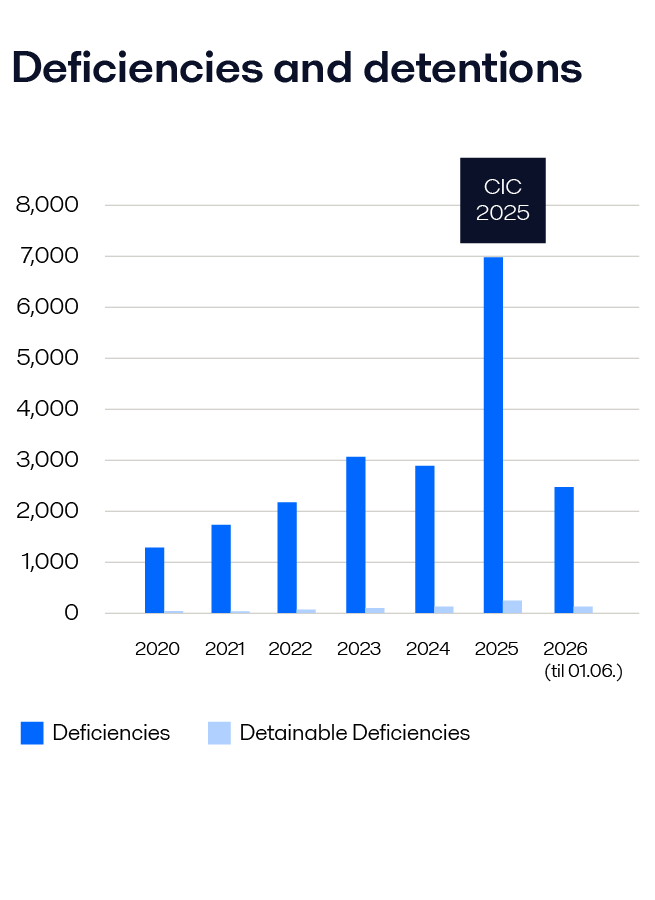
In practice, many vessels have failed to meet these simple conditions during port state control inspections. While vessels are seldom detained for individual deficiencies, ballast water management has played a role in numerous detentions.
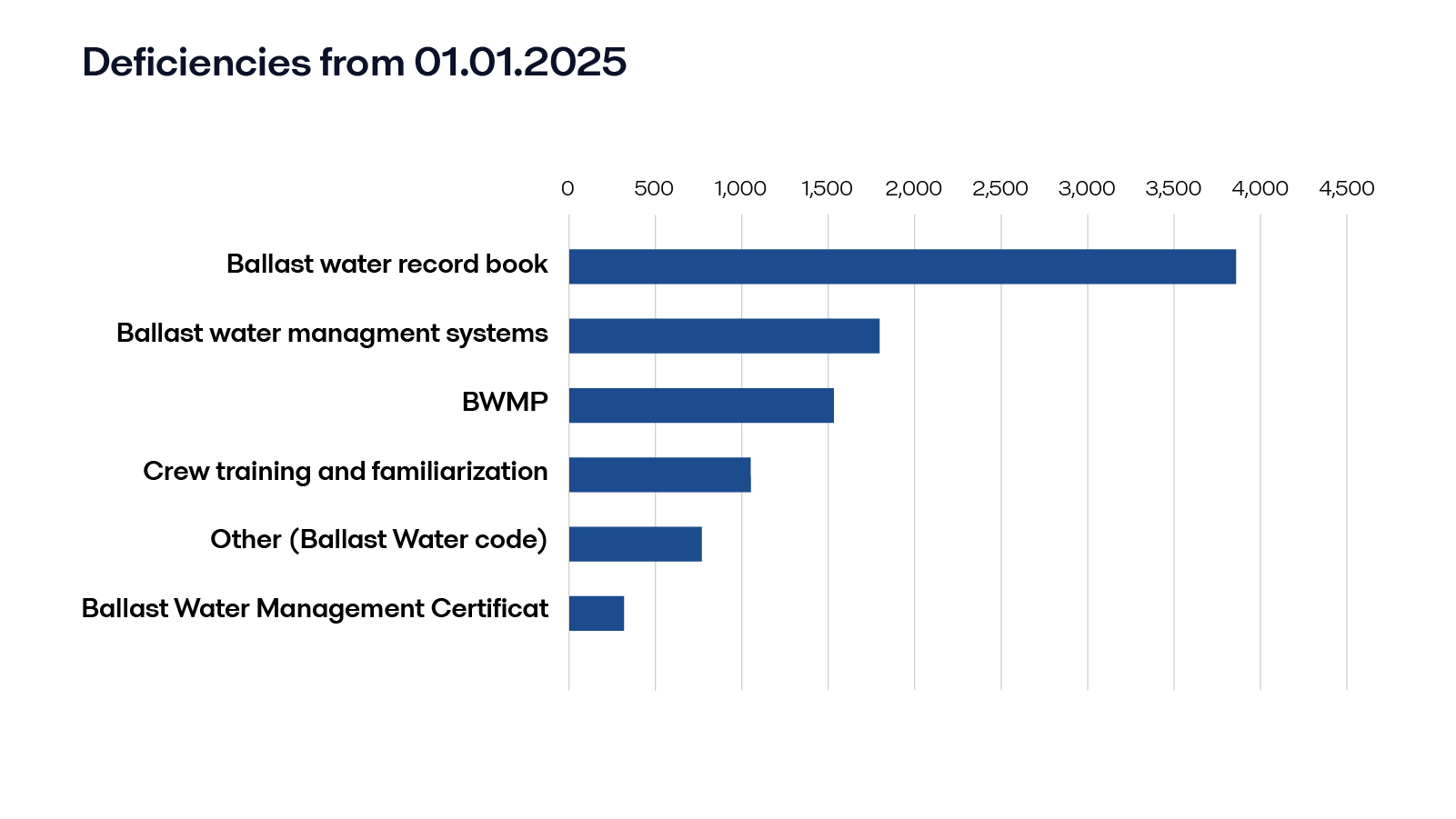
The charts below show recent deficiencies in ballast water management, based on Memorandum of Understanding (MoU) data. The most common are deficiencies in the Ballast Water Record Book, where either the entries were not made properly or the book itself was missing.
It isn’t enough to simply have a BWMS on board. To avoid issues during the operation of the ballast water management system, both the BWMS and the crew must be prepared.
Steps to ballast water management compliance
In order to comply with BWMS regulations, you’ll need to be compliant in multiple perspectives.
- Document readiness
These include:
- The International Ballast Water Management Certificate for your vessel. This certificate can only be issued after biological commissioning testing of the installed BWMS.
- An approved Ballast Water Management Plan. This must detail a wide range of routines, from ballast water management itself to safety procedures and BWMS maintenance. While not strictly required, it’s also a good idea to include procedures for challenging water quality (CWQ) and contingency measures that the vessel will rely on.
- Your Ballast Water Record Book, which should follow the updated guidance that entered into force in February 2025. All BWMS operations must be recorded in a timely manner and with the correct codes.
Be sure these documents are accessible, correct and in line with today’s requirements.
2. System readiness
Port State Control officers will expect your BWMS to be in good working order. They will check the state of its key components and make sure the treatment process is functional. If your BWMS uses active substances, they will also check that sufficient consumables are on board. Generally speaking, you should keep an eye on all critical inventory - including spare parts - so that system readiness is always possible to restore.
In short, your BWMS must be properly maintained and able to operate according to its type approval. If you need guidance, Alfa Laval is here to help - with expert advice and dedicated packages for maintenance support to keep your PureBallast system performing at its best.
3. Crew readiness
Above all, your success in ballast water management depends on the crew – who must handle BWMS maintenance, BWMS operations and the ongoing documentation of ballast water management. Port State Control officers might check that crew members understand and fulfil their duties, even under challenging water quality (CWQ) conditions. In addition, there must be a designated crew officer with responsibility for ballast water management procedures and documentation.
BWMS logs and alarms will be compared against the Ballast Water Management Plan and entries in the Ballast Water Record Book. So crew knowledge and follow-through are vital. Reach out to Alfa Laval to arrange proper PureBallast BWMS training, and discover our connectivity solutions that can facilitate accurate record keeping.

Top tips for success in ballast water management compliance
To help you be compliant in ballast water management, we’ve prepared a concise but specific set of tips. Here you’ll find more about individual items that for example Port State Control officers may be looking for when conducting inspections. In addition, you’ll learn where you can turn for additional guidance.
MEPC 84 Update
The marine environmental protection committee met end of April 2026 and managed to finalize the draft amendment to the ballast water management with a view to adopt at the next meeting.
- The amendments to the BWM Convention (Link to all draft amendments) were approved at MEPC 84 and circulated for adoption at MEPC 85 (Dec. 2026).
- The enter into force will await the adoption of the BWMS code tentative at MEPC 87 (oct. 2027) thus both instruments are expected to enter into force in spring 2029. The Experience building phase will end with the amended convention entering into force.
- Associated guidelines to the convention will be amended after the MEPC 85, these will revoke the current resolution at the same time as the amendments to the convention enters into force.
- Regulation A-3 - modified to add an exemption for ships discharging untreated water on the high seas following contingency measures
- Regulation B-1 - added additional requirement to the ballast water management plan such as maintenance procedures and schedules and procedures for BW exchange
- Regulation B-2 - will require ships to record maintenance on the BWMS either in their onboard maintenance system or in the Ballast Water Record Book
- Regulation B-6 - modified to require evidence of crew training of BWM to be kept onboard
- Regulation D-2 - added maximum allowed discharge concentration of Active Substances (TRO) to the discharge criteria (previous only biology)
- Regulation E-1 - will require ships to conduct biological sampling to verify compliance with D-2 during the intermediate and renewal surveys and annual sampling of residual Active Substances (TRO)
- Form of the BWM Certificate - modified to remove D-1 approval and to indicate that the BWMP has been approved and reviewed by the Administration
The amendments are expected to enter into force no earlier than the in spring 2029.
This will also end the Experience building phase and the non-penalization period for non-compliance with D-2 discharge criteria.

Support for Alfa Laval PureBallast owners
As a PureBallast owner, you can count on comprehensive assistance from Alfa Laval. We’re ready to support you, from answering your service questions and urgent needs for PureBallast spare parts to providing guidance on procedures for challenging water quality (CWQ). In addition, we have specific service offerings that can help prepare crews and PureBallast systems for success in ballast water management compliance.
PureBallast training
Crews must be able to demonstrate their familiarity with the BWMS on board. They need to show that they understand their duties in ballast water management – and that they are able to fulfil them. So make sure they have the knowledge they need to operate and maintain PureBallast. We offer a range of PureBallast training options, including e-learning.
PureBallast compliance service package
For BWMS, the IMO and USCG regulations demand maintenance according to the manufacturer’s instructions, as well as crew familiarity with the system. With the PureBallast Compliance Service Package, our experts take responsibility for these aspects and more - taking work and worry off your shoulders. The package combines everything you need for compliance with a predictable preventive maintenance cost.
Updated VisuALog software
Be sure you have the latest offline version of the Alfa Laval VisuALog software that was delivered with your PureBallast system. (If your version is older than VisuALog 3.0, please contact us to update.) VisuALog creates easy-to-understand visual reports that will simplify for Port State Control officers, who may otherwise have difficulty interpreting BWMS logs.
With VisuALog, you can easily verify that all BWMS operations have been entered into the Ballast Water Record Book. Using the online version, you can do this without manually retrieving log files. The online version of VisuALog is integrated into PureBallast Connect, a digital service portal that offers many additional possibilities.
Need other assistance?
As an Alfa Laval PureBallast owner, your success is our priority. We’re here to help, whatever support you need. Simply get in touch.
Related services
Evaluating BWMS replacement
There has been many deficiencies already identified among BWMS by different Port State Controls. If you currently have BWMS issues and your supplier is unable to support you, BWMS replacement may be an option worth examining.
Understanding challenging water quality (CWQ)
He crew must be able to understand and follow Ballast Water Management Plan correctly. Before performing a reactive bypass in CWQ conditions, you must consult the authorities – unless the procedure is clearly defined in your plan. Make sure you know what applies – and what doesn’t – by reading our white paper.
Understanding biological commissioning testing
You must have a valid International Ballast Water Management Certificate on board. This vessel-specific certificate is not the same as a BWMS type approval. To receive it, your individual BWMS installation must be verified through biological commissioning testing.