Back to lager: how Haandbryggeriet is brewing for a changing market
Norwegian beer drinkers are moving away from strong, heavy beers, and Haandbryggeriet is moving with them. After 21 years of brewing, the brewery now builds its core range around lager, sells a 4.5% session IPA as one of its biggest beers, and has watched its alcohol-free range take off.
Head Brewer Stephen Andrews sat down with Joakim Grell from Alfa Laval to talk about what is changing in Norwegian beer, what is staying the same, and what it means to launch every new beer in 5,000-liter batches.
Thirteen Christmas beers, all lagers
Haandbryggeriet's Christmas range runs to around 13 beers this year, and every one is a lager. Over the past year or two, the brewery has moved its core range away from IPAs and dark beers and towards pilsner.
"We're seeing a change in tastes and interest here in Norway," Stephen says. Demand for strong, heavy beers is falling, and the brewery is filling that space with Czech dark lagers and other craft lagers that are lighter and more drinkable.
The shift has reached the brewery's hoppy beers too. With so much lager in production, there is always plenty of lager yeast in-house, so the West Coast IPA has moved from ale yeast to lager yeast. For its 2,000th batch, the brewery made an 8% West Coast double IPA with lager yeast, which took more planning to have enough yeast ready.
When brewer and drinker want the same beer
For Stephen, the move to lager is not a compromise. "If you ask any brewer, they're going to tell you that they love brewing lagers," he says. He points to the history of lager production, and to pilsner as the after-brew drink most brewers reach for, himself included.
He also sees lager as the more challenging style, and one he is proud to brew at this point in his career. Consumers are leaning the same way: fewer 7% IPAs, more 4 to 5% lagers.
The result is a rare alignment. What Stephen wants to brew, what he wants to drink and what Norwegian consumers are asking for now point in the same direction.
Listening to the market without chasing trends
Haandbryggeriet hears from its markets at different speeds. Bars and restaurants in Norway are a direct link and report quickly on what is working. Grocery stores and Vinmonopolet, the state-run retail monopoly, are "a different animal", where results come through over a much longer period.
That feedback is clear about lighter beers. One of the brewery's biggest sellers is a 4.5% session IPA, which has driven growth because it is light but still full of flavor. "It's something people can drink a few of," Stephen says. Lager sales rise every year, from pilsner to Vienna lager and Czech dark lager, and lower-alcohol beers are gaining ground in HoReCa too.
Responding to demand does not mean chasing trends. "This brewery is 21 years old, so I would say we're known for classic styles," Stephen says. Apart from a couple of hazy IPAs, the range sticks to simpler classics such as porter and pale ale, and customers expect exactly that.
Rice, seven breweries and a measured approach to hops
As a legacy brand, Haandbryggeriet keeps its core beers consistent and mostly sticks to the hops and grains it has used for years. "Continuity is important," Stephen says. But there is still room to experiment, often prompted by customers.
When a local restaurant wanted a beer for its menu, the brief was simple: "Okay, try our food." The result was a new rice saison, the first time the brewery has used rice in its 20-year history. With rice lagers trending and many breweries making them, a rice saison was a way to do something different.
Collaboration brings in new ingredients too. The Batch 2000 West Coast double IPA was brewed together with seven breweries, each choosing hops they thought would pair well. That has given Stephen the chance to work with hops he had never used before.
On advanced hop products, the brewery is taking a measured approach. It is considering hop extracts to reduce the organic load on the hot side, and has experimented with thiolized yeast to get better results from the T90 pellets it already uses. With few extremely hop-forward hazy beers in the range, the newest terpene-based products are not a priority.
Brewing at 5,000 liters a batch
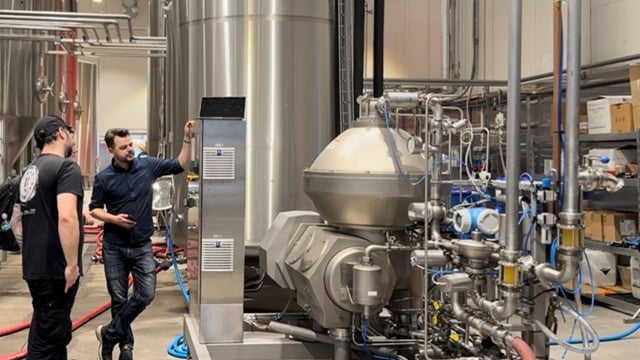
Haandbryggeriet runs a four-vessel, 50-hectoliter brewhouse, usually one brew a day, five days a week. That is 5,000 liters per brew, with capacity to do more. The cellar combines 50 and 100 hl tanks with 200 and 250 hl bright tanks.
The batch size makes experimenting harder. Specialty beers can be brewed in 35 to 40 hl batches, which works better for stronger beers, but most new beers start at the full 5,000 liters. "It's a lot of pressure sometimes," Stephen says. Every batch has to sell.
More than 60% of production goes to grocery stores, and the taproom does well, especially in summer with outdoor serving. HoReCa is picking up, and so is export. About 15 years ago, the brewery exported an estimated 30 to 40% of its beer; that fell away, and now it is growing again. The Netherlands is a strong market, the brewery is back in the UK, Sweden is doing well and Denmark is a new market again. "Norway is a small market," Stephen says, "so it's really nice to see our brand out there in the world."
From the IBU wars to quaffability
Asked where the market is heading, Stephen starts with alcohol-free. Haandbryggeriet began making alcohol-free beer about two years ago, and it has "just exploded". He calls it a huge driving force.
Ready-to-drink cocktails (RTDs) are growing in Norway too, and the brewery makes some on its own equipment. For beer, the trend is lager. "I think a lot of the players here in Norway are producing more lager just because that's what people are drinking," he says.
That is a long way from the early 2000s, when craft beer was taking off and drinkers wanted extreme flavors and bitterness, the era of the IBU wars. Stephen welcomes the pendulum swinging back towards sessionability, and is looking forward to what comes next.
Brewing for a changing market
Haandbryggeriet's story shows how a brewery can follow changing tastes without losing what it is known for. Lager now leads the range, lighter beers are driving growth, and new ideas come from customers and collaborators rather than from chasing every trend.
Whether you brew in small batches or at full commercial scale, the same questions apply: what your drinkers want next, and how flexibly your brewery can respond.