
Excellent corrosion and oxidation resistance
Outokumpu Polait case story - Diabon F100 PHE
DATE 2025-12-16The corrosive and oxidising properties of the service media used in the stainless steel pickling lines at Outokumpu Oy Polarit in Tornio, Finland, made finding a process heat exchanger a challenge. Mixtures of nitric acid and hydrofluoric acid at temperatures up to 60°C (140°F) ruled out the use of metallic materials and normal synthetic resinimpregnated graphite.
Therefore, Outokumpu decided to purchase Alfa Laval’s graphite plate heat exchanger in Diabon F100, a fluoroplastic (PVDF) bonded graphite composite material known for its corrosion and oxidation resistance.
Outokumpu use mixtures of nitric acid (HNO3) and hydrofluoric acid (HF) to remove the chromiumdepleted surface layer from their stainless steel after the cold and hot rolling mills. Normal mixtures contain between 12 and 15 percent nitric acid and 2 to 5 percent hydrofluoric acid. The high fluoride concentration rules out the use of metallic materials while the oxidising properties of nitric acid preclude the use of synthetic resin impregnated graphite.
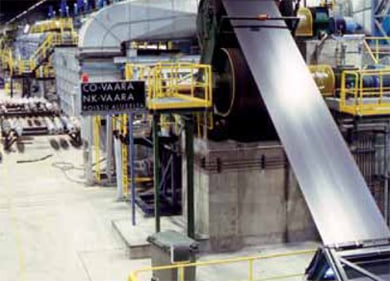
The production of stainless steel at Outokumpu Polarit Oy in Finland.
Outokumpu Polarit Oy have four HF/HNO3 pickling lines and needed a battery of heat exchangers to perform both heating and cooling duties in all of the plants. Therefore, in 1993 Outokumpu decided to test Alfa Laval’s Diabon F100 graphite plate heat exchanger for temperature control of pickling line no. 3. The results were so successful that Outokumpu now have a total of 12 Diabon F100 plate heat exchangers serving all four pickling lines. Two units serve each pickling line with an extra unit standby for each line.
Jarmo Sivonen, head of process development at Outokumpu, confirms that it was Diabon F100’s excellent resistance to oxidisation that initially influenced them to use Alfa Laval’s graphite unit. “However, easy maintenance was another important factor,” adds Sivonen. “During startup of one pickling line, large pieces of rubber loosened from one of the rollers and fastened in the inlet piping to the heat exchanger. The first time this happened, Alfa Laval’s service engineer helped us but, since then, our maintenance department can easily do the job. In contrast to graphite blocks and shell-and-tube heat exchangers, service on the Diabon F100 is simple with easy access to the plates and all four connections on the frame plate.”
Outokumpu Polarit Oy
Outokumpo Polarit in Tornio produce 400,000 tons of pickled and annealed products annually. The company is a member of the Outokumpu Group, a versatile metals group operating worldwide. Its businesses focus on base metal production, stainless steel, copper products and technology. Outokumpu have operations in 30 countries and employ approximately 14,000 people.
The graphite plate heat exchanger
Alfa Laval developed the graphite plate heat exchanger for use with media normally too corrosive for various metallic alloys in cooperation with SGL Carbon GmbH of Meitingen, Germany. It is a variant of the traditional plate heat exchanger with plates in two corrosion-resistant graphite qualities: Diabon F100 or NS1. Diabon NS1 is a dense synthetic resin-impregnated high-quality graphite with a fine and evenly distributed pore structure. It is the same material used in graphite blocks and graphite shell-and-tube heat exchangers and is suitable for use with corrosive media up to 160°C (320°F).
Diabon F100 is a fluoroplastic bonded graphite composite material with unique surface properties. In Diabon F100, the graphite is encapsulated in a PVDF binder which resists oxidising media better than normal synthetic resin impregnated graphite.
This provides:
- Low fouling tendencies. The PVDF content provides a smooth non-adhesive surface which, in combination with the corrugated plate pattern, enhances turbulence which minimises fouling
- Excellent corrosion resistance
- Outstanding heat transfer properties
- Minimal plastic deformation. The fluoroplastic material maintains its shape even under pressure
- Impermeability. The material is absolutely impermeable to most types of fluid
- Robust construction and reliability. In contrast to synthetic resin-impregnated graphite tubes and blocks, Diabon F100 plates are strong and crack-resistant
- Reasonable price. In comparison to alternatives such as graphite blocks, Diabon F100 graphite units offer lower capital costs and maintenance costs
Alfa Laval in Brief
Alfa Laval is a leading global provider of specialized products and engineered solutions.
Our equipment, systems and services are dedicated to helping customers to optimize the performance of their processes. Time and time again.
We help our customers to heat, cool, separate and transport products such as oil, water, chemicals, beverages, foodstuff, starch and pharmaceuticals.
Our worldwide organization works closely with customers in almost 100 countries to help them stay ahead.

Nitric acid - concentration in percent
Products
When corrosion is an issue use the DIABON® range of plate heat exchangers. Indestructible even for the toughest media.
Benefits
- Excellent corrosion resistance
- Outstanding heat transfer properties
- Minimal plastic deformation. The fluoroplastic material maintains its shape even under pressure
- Impermeability. The material is absolutely impermeable to most types of fluid