
Breakthrough in European steel pickling
Alfa Laval has installed 13 steam-heated Alfa Laval DIABON® NS1graphite plate heat exchangers in the tandem cold rolling mill ofThyssenKrupp Stahl AG in Dortmund, Germany.
DATE 2025-12-16Largest graphite plate installation in Europe
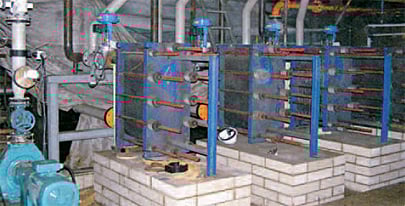 Alfa Laval has installed 13 steam-heated Alfa Laval DIABON® NS1 graphite plate heat exchangers in the tandem cold rolling mill of ThyssenKrupp Stahl AG in Dortmund, Germany. This constitutes the largest installation of steam-heated graphite heat exchangers in Europe. It is also the second-largest carbon steel pickling plant in the world equipped with Alfa Laval DIABON® NS1 graphite plate heat exchangers.
ThyssenKrupp Stahl AG is the result of the merger between the well-established steel companies Thyssen and KruppHoesch in 1997. With annual sales of almost EUR 5.6 billion, ThyssenKrupp Stahl is now the second-largest manufacturer of flat carbon steel in Europe and one of the world leaders in this market.
The company's main site is in Duisburg, Germany, where its state-of-the-art iron and steel making, processing and coating facilities are located. ThyssenKrupp Stahl also operates rolling mills and coating lines in Bochum, Dortmund, Finnentrop, Kreuztal-Eichen/Kreuztal-Ferndorf and Neuwied, in Germany, as well as Sagunto, in Spain. At the Dortmund plant, the hot rolled coils are pickled in a continuous process prior to undergoing cold rolling and zinc coating. The pickling solution consists of 73-126 g/l hydrogen chloride plus iron oxide (carbon smut) and sand (from the pickling bath brickworks). Pumps, valves and heat exchangers are protected by a lateral filter with a mesh size of 4 mm.
Comparison counts
In 2002, the company undertook a survey of the performance of the conventional graphite blocks previously used at the rolling mill in Dortmund, compared with the graphite plate heat exchangers available from Alfa Laval.
After an initial test period of 3 months, the graphite plate heat exchangers were cleaned and could be restarted after only 8 hours. Comparable maintenance and cleaning times for the block heat exchangers, on the other hand, took at least twice as long. After only 6 months of trials, the choice of technology was therefore clear.
Asked about the main advantages of the new installation, Michael Seynsche, planning engineer for the modernization of the pickling line, said: “Maintenance costs have been halved compared with the previous generation of block heat exchangers. With our CIP plant and the use of plates, we are now able to optimize the maintenance process still further. We are also very pleased with the rate of heat transfer. Another important feature is that we can add or remove plates at any time, which gives us a flexible installation. This is important because the heating needs of the individual heating zones in the pickling bath can well change over the lifespan of the rolling mill.”
DIABON®
Alfa Laval developed the graphite plate heat exchanger in collaboration with SGL Carbon GmbH of Meitingen, Germany. This heat exchanger is designed for use with media that are normally too corrosive for most metallic alloys. It is a special version of the conventional Alfa Laval plate heat exchanger design, with plates available in three different standard grades of corrosion-resistant graphite - DIABON® NS1, DIABON® NS2 and DIABON® F100.
The dense, synthetic DIABON® NS1 and DIABON® NS2 are the same type of high-quality, resin-impregnated graphite with a fine, evenly distributed pore structure. This is the same type of material that is used in graphite blocks and graphite shell-and-tube heat exchangers, and is suitable for use with corrosive media up to 180°C (356°F). DIABON® F100, on the other hand, is a fluoroplastic bonded graphite composite material with unique surface properties. In DIABON® F100, the graphite is encapsulated in a PVDF binder that resists oxidizing media better than normal synthetic resin-impregnated graphite.
The advantages of plate heat exchangers with DIABON® plates include:
- excellent heat transfer performance
- compact construction - only limited space required
- quick and easy to replace - minimum downtime
- short maintenance/cleaning times - approx. 8 hours
- rapid on-site repair
- size (number of plates) can be adjusted on site
- all parts available from stock
- replacement heat exchangers deliverable within a few weeks
- corrosion-resistant carrying bars
- easy to clean the plates using high-pressure water jet
- automatic cleaning in place (CIP) - manual cleaning of plates unnecessary
Products
When corrosion is an issue use the DIABON® range of plate heat exchangers. Indestructible even for the toughest media.
Benefits
- excellent heat transfer performance
- compact construction - only limited space required
- quick and easy to replace - minimum downtime
- short maintenance/cleaning times - approx. 8 hours
- rapid on-site repair
- size (number of plates) can be adjusted on site
- all parts available from stock
- replacement heat exchangers deliverable within a few weeks
- corrosion-resistant carrying bars
- easy to clean the plates using high-pressure water jet
- automatic cleaning in place (CIP) - manual cleaning of plates unnecessary