
Safety and savings go hand-in-hand at ITC paperboard plant in India
ITC paperboard plant, Sarapaka, Andhra Pradesh, India
DATE 2025-12-17India’s ITC Ltd. is a company with a conscience. It is directly involved in education, community development and environmental protection. And it takes the safety of its employees extremely seriously. In 2007, to protect employees from exposure to harmful gases during manual tank cleaning, ITC installed the first of over 50 of Toftejorg rotary jet heads in its paperboard plant in Sarapaka, Andhra Pradesh.
“Our number one concern was the safety of our people. Savings on manpower, downtime, water consumption and energy were welcome extra advantages.”
- Mr SVR Krishnan, deputy general manager, PBU board.
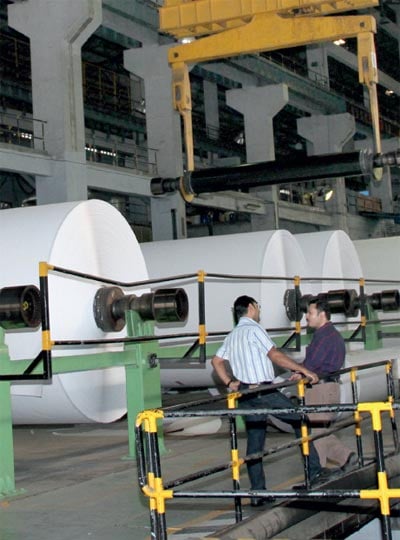
Manufacturing of specialty papers and paperboards at ITC´s plant in Sarapaka, Andhra Pradesh.
From 2 to 50+ – because they work
In 2007, when ITC began looking for a better way to clean their many tanks, automatic cleaning was almost unheard of in the pulp and paper industry. But the company did have a long-standing relationship with Alfa Laval, which had supplied them with evaporation plants, heat exchangers and other equipment.
On the basis of that trusting relationship, ITC felt confident enough to test Toftejorg rotary jet heads on their broke towers. Quickly convinced by the performance and savings they experienced, ITC has since ordered more than fifty Toftejorg rotary jet heads. “Autocleaning is going to be the order of the day, considering the overall benefit in totality with safety”, says Mr Krishnan.
How to clean tanks in less than ¼ of the time – with no hands
Savings in both downtime – for the entire production line – and manpower are significant. Mounted at the top of broke tanks, white water tanks, back water tanks, and pulp chests, for example, Alfa Laval’s Toftejorg rotary jet heads clean them automatically in an average of just an hour and a half. Manual intervention is not needed.
In comparison, cleaning tanks at the ITC plant in Sarapaka by hand used to take an average of six hours for six workers. They had to climb scaffolding in fume-filled tanks and use fire hoses and a great deal of water and chemicals to clean them.
Less water = less energy = lower costs and emissions
Cleaning with Alfa Laval’s Toftejorg rotary jet heads also cuts water consumption by as much as 1/3, which sets off a chain reaction of additional benefits: Because the cleaning process requires much less water, the pumps that feed the rotary jet heads operate for shorter periods. This in turn means that less energy is needed to run those pumps. Significant cost savings and slashed emissions are the result.
 “Our number one concern was the safety of our people. Savings on manpower, downtime,
water consumption and energy were welcome extra advantages”, says Mr SVR Krishnan,
deputy general manager, PBU board.
Toftejorg TZ-79 - eight cycles – full pattern computer-designed spray patterns ensures that every centimeter is cleaned, which eliminates the risk of dead stock and production problems. Pin-point accuracy keeps water usage to a minimum.
Products
- Continuous operation, minimum or no downtime
- Higher production capacity
- Consumption of water and detergents reduced by 75%
- Lower environmental impact: Equipment uses less energy and generates smaller volumes of waste
- ATEX Certification
Benefits
- Safer working conditions
- Zero manpower
- 1/4 the downtime
- 1/3 the water consumption
- Less energy use and lower emissions
- Cleaner tanks and higher quality products
Customer's voice
Our number one concern was the safety of our people. Savings on manpower, downtime, water consumption and energy were welcome extra advantages.
Mr. SVR Krishnan,
deputy general manager, PBU board
Company challenge
To stop exposing employees to potentially harmful gases during manual cleaning of the many tanks used in their production process.
Solution
Alfa Laval’s Toftejorg rotary jet heads provide measurable savings by cutting energy, chemicals, water consumption, downtime and manpower for virtually any tank size and configuration. They use an optimized jet impact pattern to ensure high cleaning efficiency at significantly reduced cycle times.
The high-impact dense spray pattern removes any residue after the production cycle more quickly and effectively than the much more expensive and time-consuming cleaning methods of soaking in chemicals or manual cleaning.