How Giacomo’s lifelong passion helps him get to the heart of the olive oil industry
When it comes to olive oil, Giacomo Costagli has identified a secret ingredient in his travels around the world that all the best producers include.
DATE 2026-06-02“It is passion,” says Giacomo, who, as business manager in agri-food at Alfa Laval Italy, has visited operations large and small all over the globe. “I have had the opportunity to meet producers from many different countries, and whether it is central China, Chile, New Zealand or Italy, everybody is linked by a real passion and love for olive oil.
“It is not enough just to have a knowledge of this subject; knowledge is a journey of progressive accumulation of experience and facts. Passion runs through people working in this sector, often from generation to generation, and it is something linked to the heart.”
As a proud Tuscan who comes from a farming family of olive oil producers, Giacomo’s own passion for the food is plain to see. Olive oil was part of his studies at the University of Pisa, and when he went on to take a master of science, the subject was, of course, olives.
With that background, it is no surprise that he went on to a job as an olive oil miller, which is where he first came across Alfa Laval.
“My first dealings with Alfa Laval were as a customer,” he says “As a customer I was impressed by what Alfa Laval brought in terms of passion, technology and innovation and now for me I am lucky to have the job I have now, and be able to travel the world discussing olive oil!”
The industry itself is a relatively small one, producing 3.5 million tonnes of product each year, but Giacomo notes that it is growing, driven in no small part by the health benefits that are associated with olive oil.
“It is rich in anti-oxidants, polyphenols and vitamin E,” says Giacomo. “The key to this is that the extraction of oil is usually achieved by mechanical methods, we are not using additives or solvents, and it is in this processing that Alfa Laval is leading the way with its technology and innovation.”
According to Giacomo, it is the breadth of Alfa Laval’s knowledge and expertise that gives them the cutting edge when it comes to innovation in the olive oil industry.
“Many of our competitors in this area only do olive oil, and it is sometimes used against us that Alfa Laval works in many other sectors”, he says. “But for me, it is a strength to be a multi-disciplinarian, and have that range of expertise and commitment to R&D investment because then you can transfer skills and knowledge.
“You only have to look at our history to see how Alfa Laval has driven innovation in olive oil processing, and that it will continue to do so in the future. When Alfa Laval comes out with something new, the industry knows it is based on a strong R&D approach and it sits up and takes notice.”
As an olive oil enthusiast, Giacomo is well versed in that Alfa Laval history and references 1928, when Alfa Laval was the first to introduce high-speed separation to the olive oil industry, and 1946, when it was the first to introduce decanter centrifuges. In more recent times, 2015 saw Alfa Laval introduce a patent for technology to cool down the olive paste, and in 2021, vacuum technology was first introduced to improve the extraction yield of quality oil.
“These are very significant milestones in introducing modern techniques to olive oil processing,” he says. “For someone from Tuscany it is amazing that a Scandinavian company has been so deeply involved in olive oil and leads the way when it comes to innovating, but that has certainly been the case and it continues to be so with new technology like the Olive Oil booster.”
Meeting the future of olive oil with smarter processing solutions
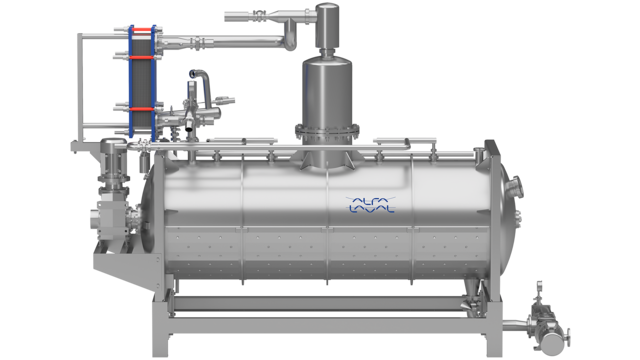
The Booster system works with a combination of thermal and separation solutions, and is designed to replace the conventional malaxer step for paste preparation in oil mills. This mechanical method is capable of de-aerating the olive paste while controlling the temperature, resulting in key process and performance benefits.
For Giacomo, this is an example of the direction technology is driving a traditionally conservative industry to meet modern demands with turnkey solutions.
“This is more of an agri-food industry; it is very closely linked to agriculture,” he explains. “This is good and bad. It can be quite resistant to change but if you are able to introduce something new – a combination solution that is not based on a standalone piece of equipment – and you get good references for that, then word quickly spreads and you have a domino effect of producers wanting to know more.”
Looking ahead, Giacomo sees solutions increasingly focusing on getting more for less, without compromising on quality, to support both the economic and environmental sustainability of the industry in the face of climactic changes.
“Agility will be the key going forward, and that is something Alfa Laval excels in,” he says. “Olive trees are already designed to make a lot with little as they are adapted to grow in dry areas and are very efficient in their water use. There are big discussions within the industry now about ensuring that the growing and processing into the future maximizes the use of resources – for the benefit of business profits as well as the environment.
“We need to keep on driving efficiency in the extraction systems and reducing the specific energy and water to produce the oil. That is the big challenge over the next 15 years and fortunately that is something that is in Alfa Laval’s DNA and we can bring in our knowledge from other sectors to devise new solutions and innovations.”
The popularity of the product, combined with climate change, has meant that olive oil production has spread from the small corner of the Mediterranean region where it has traditionally thrived, with production sites now emerging all over the world.
That ensures that the passion for the oil is spreading around the globe, as Giacomo has already witnessed, with estimates that the industry will grow by around five per cent by 2055. The global appeal is shown by the formation of the International Olive Oil Council, which defines standards and promotes the product, especially in countries where olive oil has not traditionally been part of the culture or cuisine.
“Places like China and Japan are super interested because of the taste and because of the health benefits, so the market is only going to grow,” he says. “And the fascination with olive oil is that it does not have a uniform flavour or feel. It is unique because it comes from the fruit of the plant, not the seed, it can have a different spiciness or fruitiness, which makes it an interesting foodstuff for consumption.”
Giacomo believes that climate change is having a double impact on the industry, linked to both the predictability of the olive harvest and the areas in which the olives can be grown.
“Climate change is having an effect without a doubt, and there is more volatility in production, with one year being a bumper crop, and the next year not so good, which can make the market challenging for producers,” he says. “And for sure, the line of latitude of places that are hot and dry enough to grow olive trees is moving north.
“However, although there may be more places that can grow olives, what the crop also needs is the right levels of sunlight during the day. Without that light you get more pests and fungi so this needs to be managed carefully and with the right technology in support. Again, this is where Alfa Laval has an important role to play over time.”
While there are clearly challenges ahead, for Giacomo, the future is bright for the olive oil industry. It may be the most expensive edible oil around, but for him, it has many qualities that make it the best.
He will continue to enjoy his visits to producers around the world to share a passion which now transcends borders, cultures and languages.
“Wherever you go in the world, what you see now from a sales perspective is that customers are much better educated in the emerging technologies and what is available, because they have already gone online and done their research,” he says. “They are already at stage two, and what they want from seeing you is to build a relationship and know that they can trust you.
“I say all the time that we do not do technical sales to customers. I am a technical guy, sure, but in this sector, we do sales based on emotional connection. You have to win the trust of the customer, and once you have that and they feel your passion for the product, then they will follow you.”