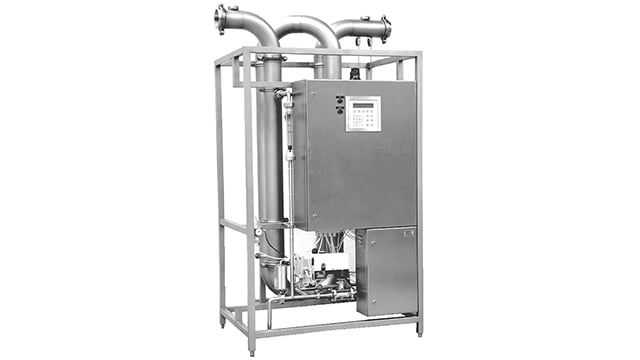
Alfa Laval Carboset Mini boosts CO₂ utilization and carbonated beverage capacity
For Canman, carbonation is business-critical. It affects safety, product quality, and margins on every can produced. The company manages up to 10 new launches each month — from soft drinks and energy drinks to still and sparkling wines. Multiple recipes. Fast changeovers. Tight timelines. No room for deviation.
DATE 2026-02-23If we over-carbonate by 0.1 or 0.2 units, a can will explode. Precision is everything.
Rasmus Carlsson, Site Manager.
Seamless installation, immediate results
To strengthen performance, Canman partnered with Alfa Laval to transition from in-tank to inline carbonation. The Alfa Laval CarboSet™ Mini, equipped with ThinkTop sensing and control units, was integrated into the existing canning line.
“The installation was incredibly smooth, and Alfa Laval’s team was absolutely great to work with, and while their support is always available when we need it. Truth is, we almost never do, which is probably the best sign that the system just works.”
Higher accuracy, greater efficiency
Previously, in-tank carbonation limited speed and scalability. Carbon dioxide (CO₂) utilization rates ranged from 50–80%, leading to gas losses and process variability. With inline carbonation, beverages now move directly from blending to filling under precise control. CO₂ utilization increased to 95–99% - an overall efficiency improvement of up to 90%. Automation ensures exact CO₂ targets are met, simplifying operations and minimizing waste.
Modular design, higher throughput, stronger margins
The impact goes beyond better CO₂ utilization. The modular design of the Alfa Laval solution allows Canman to expand capacity step by step – aligning investment with demand, without disruption. Over the years, Canman has gradually increased daily production nearly eightfold while improving consistency.
“With Alfa Laval, we’ve grown from producing about 3,000 litres a day to over 26,000, while improving consistency, increasing capacity, and significantly reducing CO₂ usage. “
By switching to inline carbonation, Canman didn’t just improve its carbonation process; it introduced a scalable platform for continued growth. More precision. Less waste. Higher throughput. Stronger margins.
Efficiency and capacity gains
- Automated carbonation and less manual work
- Up to 90% higher CO₂ utilization
- Eightfold increase in daily output
- Reduced waste and greater consistency