
2026-01-23
Experts and bold leadership as catalysts for 2026 - key takeaways from COP30
The business case for decarbonization, adaptation and water efficiency is no longer a theory – it’s here, it’s proven, and it’s urgent. At COP30 in Belém, Brazil, Alfa Laval manifested that transformation isn’t just possible; it’s scalable and vital. So why isn’t progress happening faster? The answer lies in collaboration - across value chains, between sectors, and through a focused, systemic approach where technology leaders and experts pave the way.
COP30 brought together global leaders, businesses, and civil society to push forward on the 1.5°C target. The message was clear: solutions are cost-effective, within reach, and ready to be put into action. Significant investments are driving innovation, and progress is happening - but not at the pace we need. What’s required now is quick implementation, strong leadership, and meaningful public-private partnerships. Something that is easy to talk about, but less easy to forge into reality.
“The world faces many challenges, but also many opportunities. By multi-collaborating across sectors and value chains, we can scale energy efficiency solutions with countries and industries that are ready to make a difference. Together, we can prove that collaboration delivers real and tangible results. From electricity to heat, from industrial heat reuse to heat pumps, and more, we have the technology ready. The task is to make the benefits visible and scale. Energy efficiency is a business case when applying the right competences and existing technologies,” says Thomas Møller, President of the Energy Division, Alfa Laval.
“A lot of attention has been paid to the energy transformation. For impactful climate action, the whole value chain in the food sector must be included. Today, food production accounts for almost a third of all greenhouse gas emissions and uses close to a third of all available energy. To push forward on the 1.5°C target, we must address the food value chain, reducing food waste which today accounts for up to 30 percent of the food supply, and securing energy and water efficient processing,” says Lars Dithmer, Business Unit President for Food Systems, Alfa Laval. “We are glad to see that the world’s food systems are higher up on the agenda this year. Practical examples from Alfa Laval and across industries show that technology and collaboration can make real change happen. Now is the time to embrace the solutions already available.”
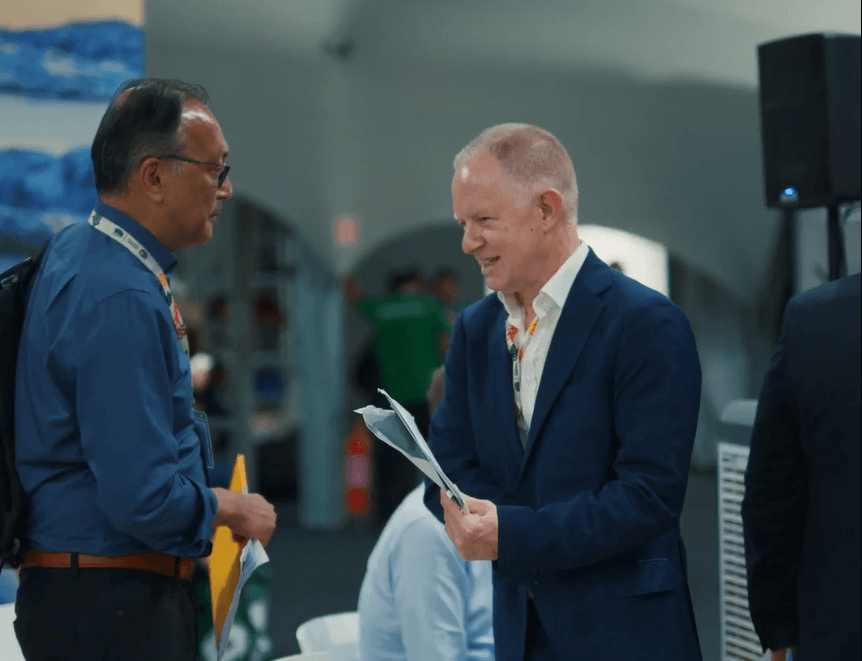
Lars Dithmer during Agrifoods Summit at COP30
Four Alfa Laval key takeaways for 2026 and beyond
- Adaptation and decarbonization go hand in hand – we need to simultaneously work to mitigate climate change all while strengthening resilience across vital industries.
- Solutions exist and are ready to be deployed with speed and at scale.
- Stronger collaboration across value chains is needed, where public and private sectors work hand in hand to drive systemic change.
- Energy efficiency must lead the way into the boardrooms and be part of the agenda. Energy efficiency is not only a driver for decarbonization, but also a compelling business case and a moneymaker.
Experts and bold leadership as catalysts for meaningful progress
Real change calls for trust, transparency, and partnerships across value chains, with public and private sectors joining forces to reduce risks, secure funding, and establish much-needed policies and standards. Trust is built on expertise, experience and knowledge – hence a factual discussion including experts within each field, backed by decisive leadership, would serve as the reassurance for bold decision-making and progress.
“Collaboration is the foundation for scaling solutions and building trust across industries and communities. We need experts on these topics sitting down, face-to-face to work closely together and daring to try new things, because everything is new if you want true change”, says Anna Celsing, Head of Sustainability, Alfa Laval.
Hands-on impact: Commitments across industries
Alfa Laval’s commitment covers the entire value chain, from creating diverse partnerships and supporting cross-sector investments to delivering innovative solutions in food, pharma, water, energy, and marine transportation.
During COP30, Alfa Laval participated in a series of high-level panels and roundtable discussions involving governmental representatives, city officials, international organizations, and leading companies, where our case studies and hands-on solutions were used as examples of how we can drive progress already today:
- Recovering excess heat from data centers
With AI and digitalization on the rise, data centers use massive amounts of electricity, with 90 percent turning into waste heat. Alfa Laval’s heat recovery solutions repurpose this energy, cutting carbon emissions and improving energy security.
Tip: Data center operators can explore waste heat recovery to reduce costs and emissions.
- Industrial heat recovery
Industries account for 30 percent of global energy use. By integrating industrial waste heat into district energy systems, we can enhance energy security and lower costs.
Tip: Partner with local utilities to channel excess industrial heat into community heating networks.
- Progressing sustainable food production
Feeding a growing population sustainably is a major challenge. Alfa Laval’s technologies enable energy and water efficient operations, help preserve food, thus reducing food waste and lessen the environmental impact of food production through plant-based protein alternatives.
Tip: Food producers can adopt circular water systems and plant-based protein technologies to build resilience.
- Water recycling and efficiency
Water is a limited resource. Alfa Laval’s facilities in Saudi Arabia and Brazil recycle nearly all operational water, setting a high standard for industrial water management.
Tip: Implement water recirculation and rainwater harvesting to minimize your facility’s water usage.
- Decarbonizing marine transportation
The joint venture between Alfa Laval and Wallenius, the Oceanbird wing sails project serves as an example of how fuel consumption can be reduced by up to 10 percent per wing. Solutions like e-methanol and voyage intelligence further support fossil-free shipping.
Tip: By adopting emerging technologies, like digital route optimization, shipping companies will experience immediate emission reductions.
- Energy Efficiency Movement
As a co-founder of the Energy Efficiency Movement (EEM), Alfa Laval is fostering industry-wide collaboration. Energy efficiency is the quickest, most cost-effective way to decarbonize, offering financial benefits from day one and with over 600 movers joining forces in EEM, the message is clear.
“Our purpose at COP30 is to highlight how Alfa Laval’s technologies can deliver immediate impact. With global energy demand rising, energy efficiency is key to accelerating the energy transition. It is not just a driver for climate progress; it’s also a moneymaker. It drives competitiveness, it drives resilience and it is the backbone of global decarbonization - and it pays off from day one”, says Anna Hall, Head of Public Affairs, Energy Division, Alfa Laval.

Anna Hall and Thomas Møller in a live broadcast from COP30
Practical steps post-COP30
- Make energy efficiency a key topic in leadership discussions, in the board rooms.
- Track energy and water use in real time to identify opportunities.
- Invest in proven technologies like heat pumps, waste heat recovery, and circular water systems.
- Build cross-sector partnerships to uncover new possibilities.
- Show bold leadership to move from planning to action.
- Support experts to lead and innovate through direct collaboration.
“For Alfa Laval, the road ahead means building on the relationships forged at COP30. We will actively support the Energy Efficiency Movement’s global initiatives and are now preparing for our contributions at the IEA’s 11th Global Annual Conference on Energy Efficiency in June 2026. Above all, we remain committed to showcasing how energy efficiency is a moneymaker and how it reduces emissions, enhances resilience, and maximizes operational efficiency”, says Anna Hall.
Tags
All