
Échangeurs de chaleur à plaques et joints
Que ce soit notre gamme industrielle polyvalente ; la gamme industrielle semi-soudée pour la réfrigération et les process exigeants; la gamme hygiénique pour les applications agroalimentaires et pharmaceutiques; ou la gamme spécialisée pour la condensation, l'évaporation et les supports fibreux - vous achetez pour un coût de possession réduit, une efficacité et une sécurité accrues.
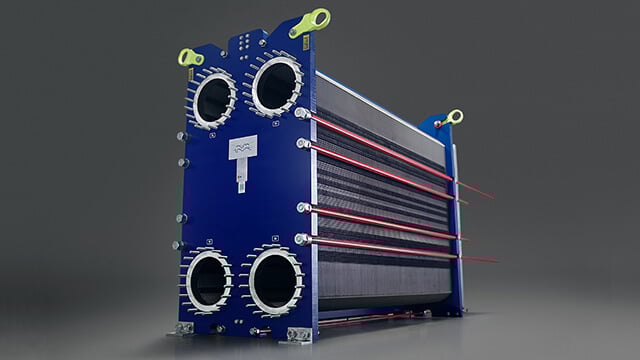
Des échangeurs de chaleur à plaques et joints qui répondent à vos exigences
- Efficacité thermique maximale
- Unités compactes - gain de place, facilité d'entretien et de maintenance
- Disponibilité maximale - moins d'encrassement, moins d'effort, d'usure et de corrosion
- Flexible - facile à adapter aux nouvelles exigences
Nos échangeurs de chaleur à plaques et joints optimisent le transfert de chaleur grâce à de grandes surfaces de plaques tirant la chaleur d'un gaz ou d'un liquide à l'autre. Ils offrent une efficacité et une fiabilité exceptionnelles dans une conception compacte. Les échangeurs à plaques et joints d’Alfa Laval offre le coût total de possession le plus attrayant sur la durée de vie du produit. Sans oublier les capacités d'économie d'énergie et la faible empreinte environnementale.
Découvrir la technologie des plaques et le principe de fonctionnement
Industrial line
Our wide range of industrial gasketed plate heat exchangers is suitable for all types of industry and multiple applications from heating, cooling and heat recovery to condensation and evaporation.
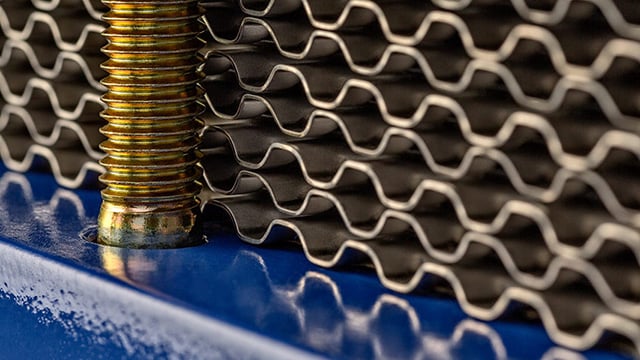
Plate and gasket technology
The design of the corrugated plates optimizes heat transfer by providing a large but compact total surface area through which the heat can be drawn from one liquid or gas to another.
The heat transfer area of the plates is pressed in a corrugated herringbone pattern. When two plates are superimposed with opposing herringbone patterns, the helix-like flow and high turbulence results in high transfer coefficients and effective self-cleaning.
A change in the corrugation pattern enables the heat exchanger to be used in different processes, even those with very dirty media.
The plate distribution area ensures an even flow of fluid over the entire plate to maximize the heat transfer capability. An optimized flow distribution also reduces fouling and uneven temperature zones keeping the performance levels high over time without unnecessary energy losses, maintenance costs or unplanned stops.
Gaskets are key components in heat exchanger performance. We design the gasket and plate as one to assure an optimized seal. Each is tailored to the duty of the heat exchanger. The correct profile, width, thickness, and polymer type and compound make a world of difference in avoiding the risk of premature leakage or gasket or plate damage. Your benefits are prolonged gasket life, less downtime and lower maintenance costs.
Distribution area
Profil de joint
Colle pour joints
Double-wall gasketed plate heat exchangers
Designed for use with fluids that cannot be allowed to mix. Prevents leaking fluid coming into contact with the fluid in the other circuit.
Wide-gap plates
Ideal for fluids containing fibers or coarse particles. Designed to eliminate bridging of solids in the entrance area.
Semi-welded plates
Enable aggressive and difficult fluids to be handled, and also extend the pressure range.
Diabon™ graphite non-metallic plates
A composite of fused graphite and fluoroplastic provides excellent resistance to corrosive materials.
How plate heat exchangers work
The concept behind a heat exchanger is relatively simple – heating or cooling one medium by transferring heat between it and another one.
In a gasketed plate heat exchanger, the plates are fitted with elastomeric gaskets which seal the channels and direct the media into alternate channels. The plate pack is assembled between a frame plate and a pressure plate, and compressed by tightening bolts fitted between these plates. The channel plates and the pressure plate are suspended from an upper carrying bar and fixed in position by a lower guiding bar, both of which are fixed to the support column. The design allows easy cleaning and simple capacity modification (by removing or adding plates).
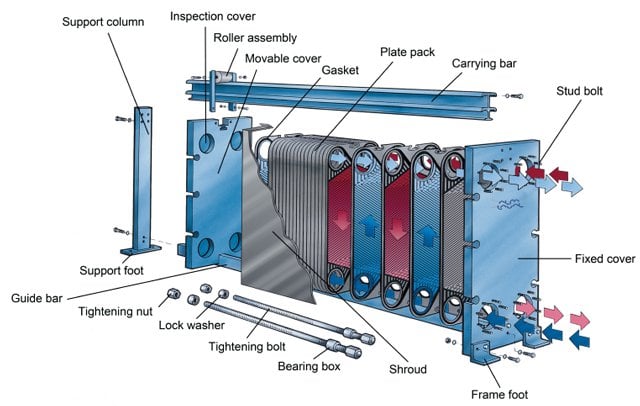
The heat transfer area of a gasketed plate heat exchanger consists of a series of corrugated plates, assembled between a frame and pressure plates to retain pressure. Gaskets act as seals between the plates. Fluids normally run counter-currently through the heat exchanger. This gives the most efficient thermal performance and enables a very close temperature approach, ie the temperature difference between the exiting process medium and the entering service medium.
For heat sensitive or viscous media, co-current flow can be used to let the coldest fluid meet the hottest when entering the heat exchanger. This minimizes the risk of the media overheating or freezing.
Plates are available with various pressing depths, angles of chevron pattern and various corrugation shapes, all carefully designed and selected to achieve optimal performance. Depending on the application, each product range has its own specific plate features.
The distribution area ensures fluids are evenly distributed across the entire heat transfer surface and help avoid stagnant zones that may cause fouling.
While high flow turbulence between plates results in higher heat transfer, the consequence is pressure drop. Our thermal design engineers can help you design and select the model and configuration that is suitable for your application so that it delivers maximum thermal performance with minimum pressure drop.
Conventional gasketed plate heat exchangers
Alfa Laval liquid/liquid gasketed plate-and-frame heat exchanger
Alfa Laval steam heater gasketed plate-and-frame heat exchanger
Alfa Laval 2-pass gasketed plate-and-frame heat exchanger
Hygienic applications
Specific applications
Service to extend the performance
A poorly functioning heat exchanger may affect safety, product quality and energy costs. Failure may lead to costly downtime and major losses in production. By regular and proactive maintenance performance is preserved and operations kept trouble-free and predictable.
All heat exchangers lose performance over time. Alfa Laval's cleaning equipment (CIP) provide quick and easy in-line cleaning, but we recommend sending the units for recondition on a regular basis to reset the status of your equipment to an as-good-as-new condition. A Performance Audit by a qualified engineer, give you an assessment of the current state of your units, which makes planning for downtime easy. At reconditioning we replace gaskets, upgrade plates or replace damaged ones – all spare parts used are genuine Alfa Laval according to original specification. This is important to secure the sealing and reliability of your heat exchanger back in production.
When emergency calls, help is always close to you. Our network of service centres, factory-trained field technicians, service representatives and authorized service providers, mean that we have your parts and service needs covered for the complete range of Alfa Laval heat exchangers.
Contact your local Alfa Laval service sales to discuss Performance agreements or services exactly tailored to your need.