Optimizing brewery operations: improving efficiency, productivity, and process performance
In an industry where brewers of all shapes and sizes are seeing change everywhere they look – from climate to consumer demand – the need to optimize operations remains a constant in an ever-shifting world.
Maintaining a drive to maximize resources and minimize waste across all stages of the brewing process can boost profitability, competitiveness and sustainability, and anchor a business against those buffeting waves of change in a turbulent marketplace.
And whether you are a global brewing giant with facilities consuming energy like a small city, or a small craft brewery tucked down an urban side street, it is important not to meet this challenge alone. Teamwork and partnership are the keys to keeping up to speed with the latest innovations that will deliver improved efficiency, productivity and process performance, saving on cost and maximizing yield while retaining the quality of the final product.
And from separation to heat transfer and flow control, Alfa Laval’s R&D has driven process optimization in one of the most resource-hungry industries.
Innovative water stewardship
Any discussion about optimizing brewery operations should start with water. As one of the biggest industrial users of this precious commodity, careful water stewardship has become increasingly important.
As the climate warms, water becomes scarcer in many areas, the cost of its use and its disposal increases, local regulations become tighter, and ensuring you can make the maximum amount of beer using the minimum amount of water becomes an imperative.
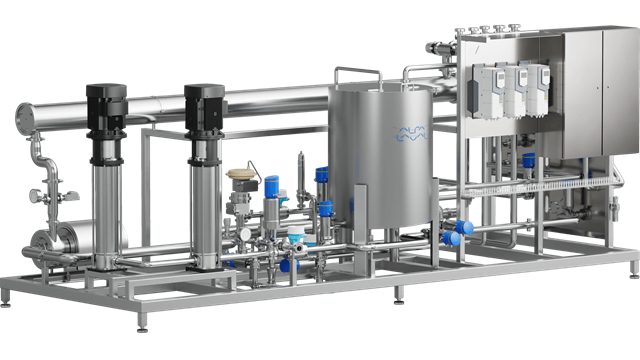
This imperative drives innovation, and technology such as the Revos system from Alfa Laval has been developed to revolutionize beer-making operations.
The system uses a patented two-pass reverse-osmosis to allow brewers to concentrate their beer – both alcoholic and non-alcoholic – and recover around 70% of water at food-grade levels, for reuse.
In the first stage of the process, the beer passes through proprietary membrane elements under high pressure, and while water permeates through, the alcohol, proteins, sugars, aromas, and minerals remain in the concentrate.
The second phase sees the alcohol and aromas recovered and then recombined with the concentrate, ensuring it matches the original beer specification.
This high-quality concentrate has up to 22% alcohol by volume (ABV) and can then be transported to consumer destinations where it is rehydrated with the same taste, aroma, minerals and alcohol content as the original product, using carbonated water in bottles and cans or Alfa Laval’s own draft dispensing unit for bars and restaurants.
Advanced energy saving
It’s a case of revolutionary thinking to revolutionize drinking, and it can only be achieved because Alfa Laval has a long and successful history of working with the brewing industry, and has got under the skin of the operations and day-to day-challenges.
From the brewhouse to packaging to cleaning, tweaks in systems or major process overhauls, such as that delivered by Revos, can come together to boost operational performance.
Alongside systems that offer water-saving and circularity, the technology also tackles the challenges of an energy-hungry production process, and with energy costs on the rise globally, that is vital for brewers big and small.
Alfa Laval’s Intelligent Whirlpool System, for instance, reduces both energy and water consumption during wort preparation to raise brewhouse performance and increase brewing yield.
Meanwhile, Alfa Laval works with a number of partners that are focused on energy reduction, green hydrogen, long-term energy storage, and similar, offering huge opportunities in brewing, where a lot of power can be self-generated.
It is this kind of advanced technology and thinking that puts brewers on a firm footing when it comes to meeting the other challenges that the industry throws at them, such as the need to diversify their operations and develop low and no-alcohol products to meet modern consumer tastes.
The power to diversify
It is all very well attempting this diversification, but if it is delivered with a lack of expertise and experience, and comes at the price of efficiency loss then this can have major impacts on profits and competitiveness.
Working with a partner who is across all the latest developments in the production of low and no alcohol beers, and also the processing of ready-to-drink beverages and hard seltzers, ensures that efficiency and process performance are maintained while new products are created and new markets are reached.
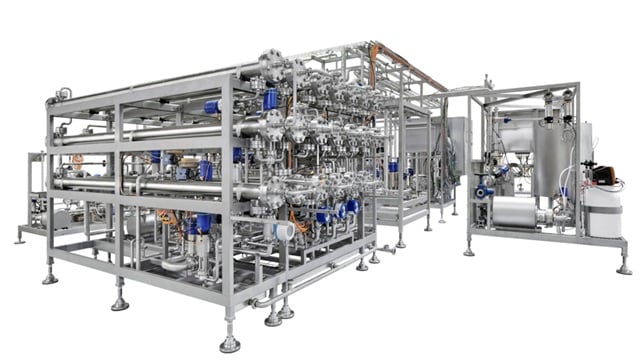
Alfa Laval’s Low-alc de-alcoholization module is just such a piece of technology, removing the alcohol through a membrane filtration of three steps, with efficiency to the fore at each step.
First, there is the upconcentration, where the beer is concentrated to approximately three times its original strength, then the diafiltration, which sees deaerated water flushing alcohol from the concentrate, and finally comes the refilling, where the system refills the batch tank with deaerated water to restore original volume and reach the desired alcohol level.
At each step, the technology’s gentle handling ensures minimal product loss and maximum efficiency in this new and evolving process.
Meanwhile, reliable, affordable technology like rotary jet mixers and burst-clean valves ensures that those same lines that produce quality ales can also be easily cleaned and repurposed to make seltzers, soft drinks and energy beverages, with minimum water and energy use and reduced downtime to boost overall process efficiency.
Tried and tested technology
Alfa Laval will stay at the cutting edge when it comes to refining and further developing these technologies designed to meet shifting consumer preferences, but will not lose focus on delivering the fundamental technology behind every good brewing operation to be the most efficient available.
The Iso-Mix rotary jet system, for instance, delivers on-point yeast management, keeping the yeast evenly mixed with wort and ensuring a faster and more effective fermentation and maturation processes, while optimizing temperature control.
Alfa Laval’s beer centrifuges have been delivering for decades, in pre-clarification, green beer or hot wort separation, and beer recovery. The process efficiency of the Brew series, with its hermetic design, means swift beer clarification with close to zero oxygen pick-up, a longer shelf life, improved haze stability, and preserved aroma and flavour. It also enables quicker tank turnover and reduced product loss, boosting yield by 5–10% compared to traditional gravity settling.
Meanwhile, in terms of treatment filtration and the blending that creates the final product, Alfa Laval’s Aldox modules ensure the highest de-aerated water (DAW) quality, with the lowest oxygen content, to ensure a premium beer.
Getting more for less
With Alfa Laval, it is all about getting more for less for maximum process efficiency, and many brewers are already seeing the benefits of deploying plate heat exchangers to power energy-recovery systems and decanters that can dewater spent grains, for water circularity.
And to ensure waste is kept to a minimum, the technology is now available to ensure what was once waste can actually be transformed into a revenue stream, as spent materials rich in proteins are extracted and harvested to be sold on for other uses, such as health products.
Such has been the technological advancements over recent years that buying, say, a new centrifuge from Alfa Laval may come with an initial capital cost, but the operational efficiency means that payback is often less than two years, sometimes quicker. In this way, brewers can future-proof their business against the challenges to come.
With technology that targets ultra-efficient processing, with fewer raw materials, minimal energy and water consumption, boosted circularity, and fewer CO2 emissions, Alfa Laval is squarely in the vanguard when it comes to delivering optimized, more sustainable operations that give its customers more bang for their brewing buck.