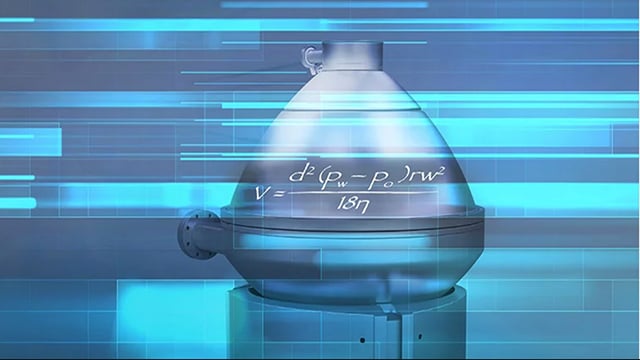
Fonctionnement de la séparation centrifuge
Les technologies de séparation sont essentielles pour un large éventail d'industries, de l'agroalimentaire, des boissons et des produits pharmaceutiques au maritime et à l'énergétique, en passant par le traitement de l'eau et des déchets.
Different separation technologies
There are various ways to separate liquid phases and solids from liquids. Two most common technologies are centrifugal separation and filtration. Decanters and disc stack separators (also referred to as centrifuges) are both centrifugal separators. In many processes both decanters, discs stack separators and filters are used, in different stages of the process - or even used in series - to achieve the required separation result.
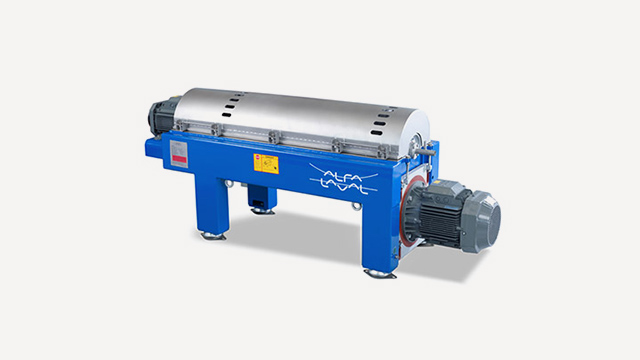
Decanter centrifuges
Decanter centrifuges remove large particles from slurries or liquids with a high concentration of solids as well as separate two liquid phases of varying densities by means of centrifugal force.
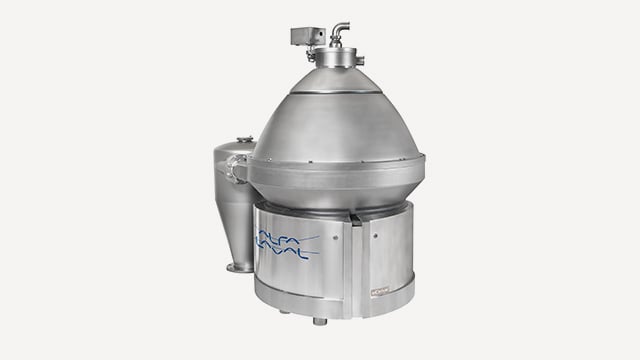
Disc stack centrifuges
Disc stack centrifuges uses centrifugal force to separate liquids with a lower concentration of solids and relatively small particle sizes. It is highly suitable for separating two liquid phases as well as a solids phase.
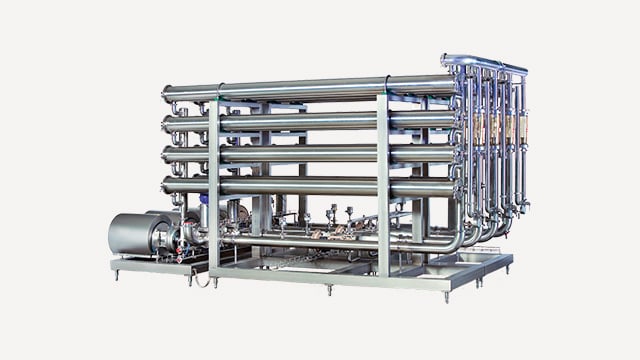
Membrane filters
Membrane filters typically handle low solids concentrations and capture the smallest particles. Membrane filters typically remove particles up to 1 micron is size, in liquids where the solids content is 5% or less.
There are various methods to separate liquid phases and solids from liquids. Two most common technologies are centrifugal separation and filtration. Decanters and disc stack separators (also referred to as centrifuges) are both centrifugal separators. In many processes both decanters, discs stack separators and filters are used, in different stages of the process - or even used in series - to achieve the required separation result.
Decanter centrifuges remove large particles from slurries or liquids with a high concentration of solids as well as separate two liquid phases of varying densities by means of centrifugal force.
Disc stack centrifuges uses centrifugal force to separate liquids with a lower concentration of solids and relatively small particle sizes. It is highly suitable for separating two liquid phases as well as a solids phase.
Membrane filters typically handle low solids concentrations and capture the smallest particles. Membrane filters typically remove particles up to 1 micron is size, in liquids where the solids content is 5% or less.
Ranges of each technology
- Decanters (liquids containing 15% or more solids + particle size is greater than 10 micron)
- Filters (liquids with solids content of 5% or less + particle size is less than 1 micron)
- Disc stack centrifuges (liquids with solids below 25% + particle size between 0.1 micron and 150 micron
- Membrane filters (liquids with up to 5% solids concentrations + particle size up to 1 micron
Designs for different separation duties
Disc stack separators are generally used for commercial and industrial separation duties that involve liquid-liquid separation and liquid-solid separation.
- Liquid-liquid separation involves two immiscible liquids of different densities.
- Solid-liquid separation involves:
- removing solids from a liquid to recover valuable by-products and discharging the liquid for treatment as effluent,
- recovering a valuable liquid from solids and discharging solids for treatment as waste,
- recover both solids and liquids as valuable products, or
- removing solids from a liquid before cleaning the liquid prior to discharge to prevent contamination to the environment. - Liquid-liquid-solid separation involves the separation of three distinct phases, which is the most challenging separation duty. Here, no other technology can compete with disc stack separation technology.
Disc stack separators are generally used for commercial and industrial separation duties that involve liquid-liquid separation and liquid-solid separation.
- Liquid-liquid separation involves two immiscible liquids of different densities.
- Solid-liquid separation involves:
- removing solids from a liquid to recover valuable by-products and discharging the liquid for treatment as effluent;
- recovering a valuable liquid from solids and discharging solids for treatment as waste;
- recover both solids and liquids as valuable products; or,
- removing solids from a liquid before cleaning the liquid prior to discharge to prevent contamination to the environment. - Liquid-liquid-solid separation involves the separation of three distinct phases, which is the most challenging separation duty. Here no other technology can compete with disc stack separation technology.
Clara 450 is an example of a separation system with a clarifier - used in the food, beverage and pharma industry.
Clarifier
A clarifier is a centrifugal separator for solid – liquid separation, that removes solids such as particles, sediments, oil, natural organic matter and colour from process liquids. In doing so, the process liquid becomes clear.
Applications
Alfa Laval clarifiers are engineered for use in various applications within food and beverage, marine and industrial fermentation industries. For instance, in beverage applications clarifiers are used in processing of fruit juices, wine, tea and coffee. In industrial fermentation clarifiers are a key component in microalgae, bacteria and yeast fermentation processes. In Marine industry clarifiers are applied for cleaning of scrubber water in system for the cleaning of exhaust gasses.
Purifier
A purifier is a centrifugal separator for liquid – liquid – solid separation, that separates two liquids of different densities, and a solids, such as water, oil, and fines, from each other. Using a purifier the light liquid phase is typically the large fraction which is meant to cleaned.
Applications
Alfa Laval purifiers are engineered for multiple applications across industries, such as food and beverage, marine and energy. These premium quality centrifugal separators are suitable for processing plants of any size. In food industry they are typically used in fats and edible oil processing, such as vegetable oils, lard, tallow and fish oil. In Marine purifiers are mainly used for the cleaning of engine lube oils.
A Flex module typically includes a purifier for removing water from diesel oil or
lube oils.
An AFPX system can be configured as a concentrator and used for fish and meat extraction processes.
Concentrator
The Alfa Laval concentrator is a centrifugal separator designed to separate three different phases, one solid phase and two liquid phases of different densities, and clean the densest/heaviest liquid phase.
Applications
Alfa Laval concentrators are widely used in various industries, such as food, beverage processing and marine applications. In vegetable oil and animal fat refining industries concentrators are used for processes continuous degumming, neutralization, dewaxing, and washing. In beverage processing they are used in deoiling and oil recovery applications, such as citrus juice de-oiling and cold pressed peel oil concentration and polishing. In Marine industry Alfa Laval concentrators are used in the cleaning of bilge water.
How does a disc stack centrifuge work? It separates solids and one or two liquid phases from one another using extremely high centrifugal forces. The centripetal force generated by the rotating bowl pushes solids against the periphery of the bowl, while the less dense liquid phases form concentric inner layers. The separation process can be either a discontinuous or continuous, depending on the amount of separated solids.
Disc stack centrifuges have different types of mechanisms to handle solids, depending on the separation duty at hand. There are three types of separator design depending on solids handling type :
- Solid-wall separator, where operation must stop in order to open the bowl so that the collected solids can be removed manually.
- Intermittent solids discharge separator, where ports at the bowl periphery automatically open at controlled intervals to remove the collected solids
- Continuous solids discharge separator, where nozzles at the periphery of the bowl allow solids and liquids continuously leave the separator during operation.
Separator components
An Alfa Laval separator consists of a number of proven functions and high-quality components. Click on the hot-spots to learn more about each.
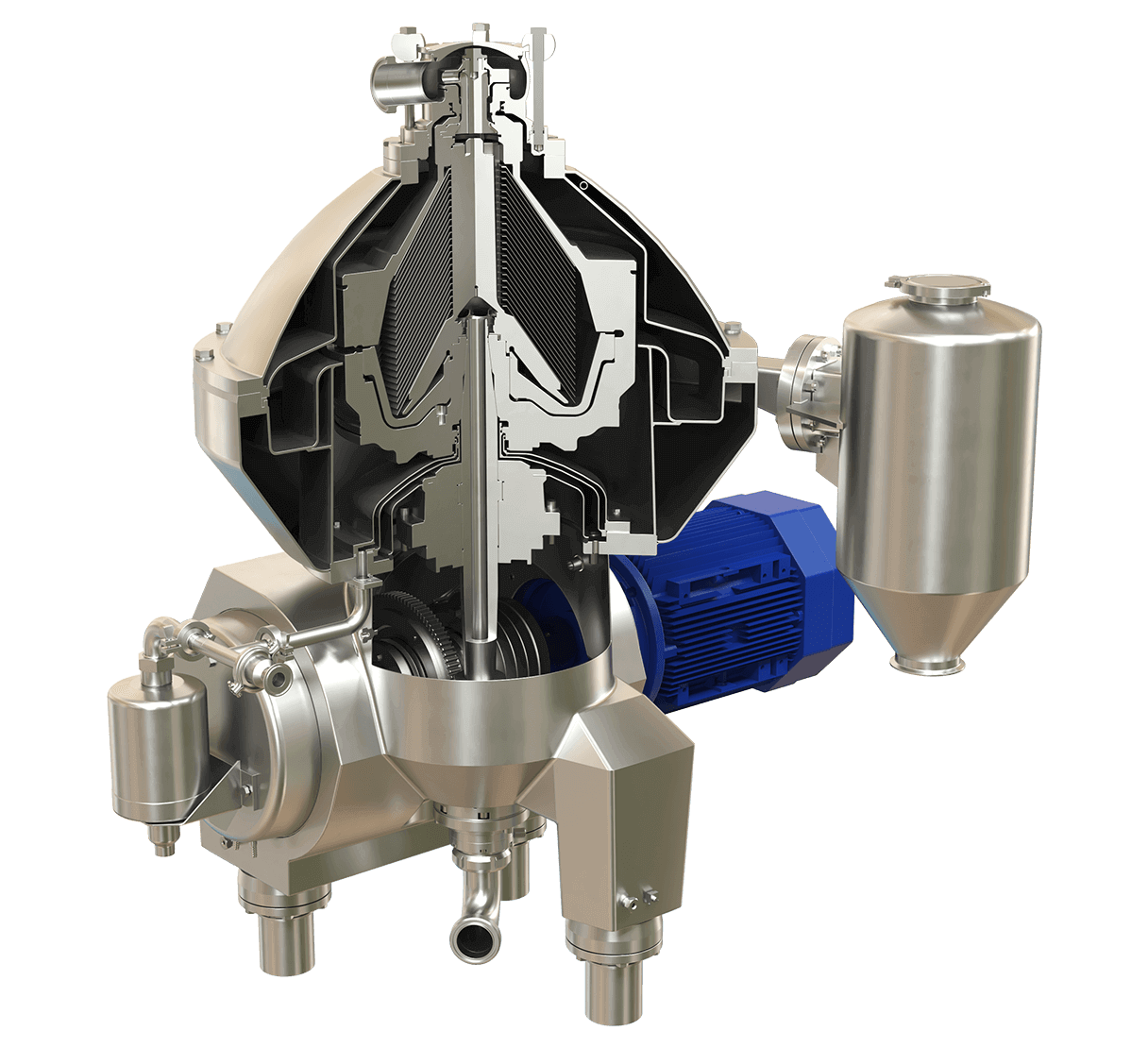
How a disc stack centrifuge works
As you see above, there are various types of separation technologies available. Separation technology involving a disc stack separator/centrifuge is used for centrifugation in which various phases of solids and liquids are isolated from one another based on the difference in densities.
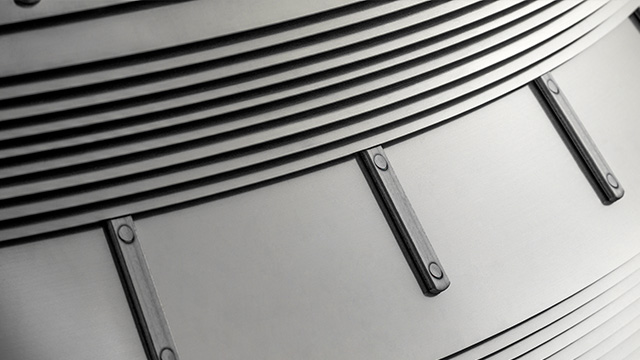
Explore our innovations
Would you like to know more about our innovations in separation technology? Click on the link below. Alfa Laval invented the first disc stack separator and has led the way in the development of centrifuge technology for over a century. We are glad to share with you the expertise we have gained along the way. Visit our Separator Innovator knowledge base to learn more about advancements in separation and the steps Alfa Laval is taking to continue revolutionizing the technology.